There’s organized, and then there’s accessible. Plenty of anglers have their tackle neatly arranged at home — color-coded trays, labeled bins, everything in its place. But the moment they’re on the water, knee-deep in a current with a fish breaking the surface 30 feet away, that organization means nothing if they can’t reach the right jig in under 15 seconds.
Accessibility isn’t just about where things are stored. It’s about how quickly you can identify, reach, and deploy what you need under real fishing conditions — wet hands, a moving boat, fading light, and fish that won’t wait while you dig through compartments. Many anglers confuse “organized at home” with “accessible on the water.” They’re two different problems requiring two different solutions.
This guide bridges that gap. We’ll cover how to set up a fishing tackle bag system—and smart tackle box alternatives — that keeps everything both organized AND instantly accessible when the moment demands speed. Because in fishing, the angler who rigs fastest often catches most.

Why Does Tackle Accessibility Matter More Than Pure Organization?
Organization is the foundation. Accessibility is what actually helps you catch fish. Here’s why the distinction matters:
Fish don’t wait: A feeding window might last 5 minutes. If you spot surface activity and need to switch from a bottom rig to a topwater, every second counts. Anglers with accessible systems switch in 30 seconds. Those who need to unzip bags, open trays, search compartments, and retie lose 3-5 minutes — often enough for the window to close.
Confidence in coverage: When you know exactly where everything is and can reach it instantly, you fish more aggressively. You’ll try technique changes you’d otherwise skip because “it’s too much hassle to switch.” This experimentation catches fish that one-technique anglers miss entirely.
Reduced decision fatigue: A cluttered, hard-to-navigate system forces you to make micro-decisions every time you need something. “Where did I put those…” × 20 times per trip adds up to significant mental drain. Clear accessibility means automatic, effortless gear transitions.
Fewer lost items: When everything has an obvious, accessible home, items return to that home naturally. When storage requires effort (digging, rearranging, forcing items into tight spots), things end up wherever is convenient — and organizational entropy takes over quickly.
What Makes a Fishing Tackle Bag More Accessible Than a Traditional Tackle Box?
Traditional hard tackle boxes served anglers well for decades, but modern fishing tackle bag designs offer significant accessibility advantages:
Multiple access points: A good tackle bag has top-loading main compartments, side pockets, front quick-access panels, and internal organizers — all reachable without disturbing other sections. A tackle box has one lid. Open it and everything is exposed simultaneously.
Tool integration: External loops, elastic holders, and D-ring attachments keep pliers, scissors, and tools on the bag’s exterior — visible and grabbable without opening anything. Traditional boxes require tools inside, buried under trays.
Soft structure flexibility: Bags conform to storage spaces — boat compartments, kayak wells, backpack pockets. Hard boxes demand their full footprint regardless of available space and often can’t be positioned at optimal access angles.
Wear-and-carry ergonomics: Shoulder straps, hip belts, and handle options mean your tackle travels with you hands-free. You reach fishing position with everything already accessible on your body. Boxes must be set down and opened — adding a step between you and your tackle.
How Should You Set Up a Tackle Bag for Maximum Quick Access?
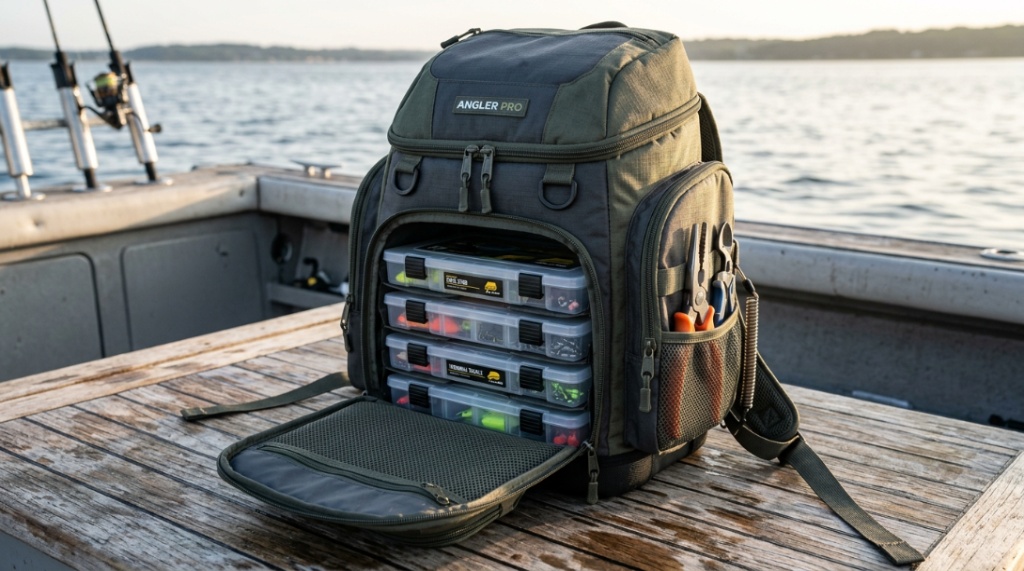
The internal layout determines how fast you can find and deploy gear. Follow this access-priority architecture:
Zone 1: Instant Access (Top pocket, external holders)
What goes here: Current lure/rig already tied and ready, pliers, line cutter, leader material for retying, backup hooks for current technique. These are items you reach for 10-30 times per trip. They should require zero unzipping — just reach and grab.
Zone 2: Quick Access (Main compartment top layer, side pockets)
What goes here: 2-3 trays holding today’s technique options. Primary and secondary pattern tackle. Alternate leader sizes. Replacement soft plastics. One zip/flap opening reveals these. Target: accessible in under 15 seconds.
Zone 3: Planned Access (Main compartment lower layers, back pockets)
What goes here: Contingency technique trays. Weather-change options. Specialty terminal tackle. You planned to potentially need these today — they’re packed specifically — but accessing them is acceptable at 30-60 seconds since they represent tactical shifts, not rapid in-play changes.
Zone 4: Emergency/Utility (Bottom compartment, buried pockets)
What goes here: Spare line, first aid, sunscreen, registration, keys, phone. Items you access 0-2 times per trip. Speed doesn’t matter; protection and organization do.
| Access Zone | Contents | Target Access Time | Bag Location | Times Accessed/Trip |
|---|---|---|---|---|
| Zone 1 (Instant) | Current rig tools, pliers, cutter | Under 5 seconds | External/top open pocket | 10-30 |
| Zone 2 (Quick) | Active technique trays | Under 15 seconds | Main compartment top | 5-15 |
| Zone 3 (Planned) | Backup patterns, contingency | Under 60 seconds | Main compartment lower | 2-5 |
| Zone 4 (Emergency) | Utility, personal items | Not time-critical | Bottom/back pockets | 0-2 |
What Tackle Box Alternatives Offer Better Accessibility?
If traditional tackle boxes feel slow and clunky, these alternatives prioritize speed of access:
Tackle Slings and Chest Packs
Body-worn systems that put tackle at fingertip level without setting anything down. Slings hang at hip height with forward-facing compartments. Chest packs position tackle literally in front of you. Both eliminate the “bend down, open box, find item” sequence entirely. Best for: wade fishing, bank fishing, anywhere you stand while fishing.
Roll-Up Tackle Wraps
Flat, visible-at-a-glance storage that unrolls to reveal every item simultaneously. No digging, no stacking, no hidden layers. You see everything in one look and grab what you need. They roll up compact for transport and unroll on any surface (boat deck, bank, rock) for instant access. Best for: lure-specific setups, leader storage, minimalist approaches.
Modular Pouch Systems
Individual MOLLE-compatible or clip-on pouches that attach to a belt, bag, or vest. Each pouch holds one technique’s essentials. You wear only what’s relevant and swap pouches between trips. Access is immediate — just open the relevant pouch at your hip. Best for: multi-technique bank fishing, wade fishing, backpacking to spots.
Magnetic Quick-Draw Systems
Magnetic patches or holders mounted on boats, bags, or clothing that hold frequently-changed items — hooks, weights, snaps, extra trebles. Items stick visibly in the open and pull free with one hand. No containers to open at all. Best for: terminal tackle quick-changes, boat fishing, items you swap every cast or every few casts.
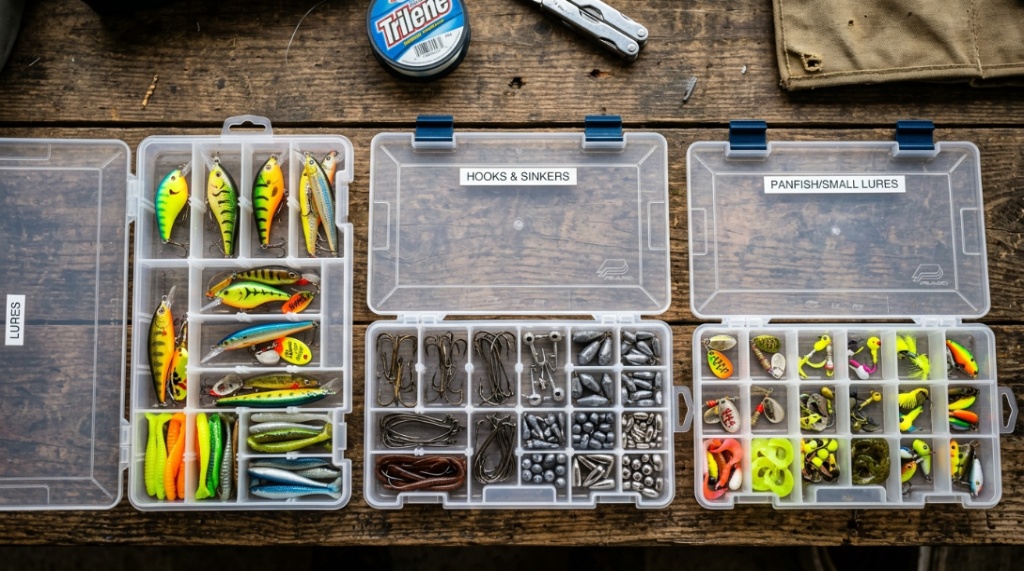
Clear-Top Convertible Trays
Utility trays with transparent lids that let you see contents without opening. Combined with well-organized dividers, you identify the compartment you need before touching the tray. This eliminates the “open, search, close, wrong tray, try next one” sequence. Best for: anglers who use multiple trays and need fast identification.
How Do You Organize for Rapid Technique Switches?
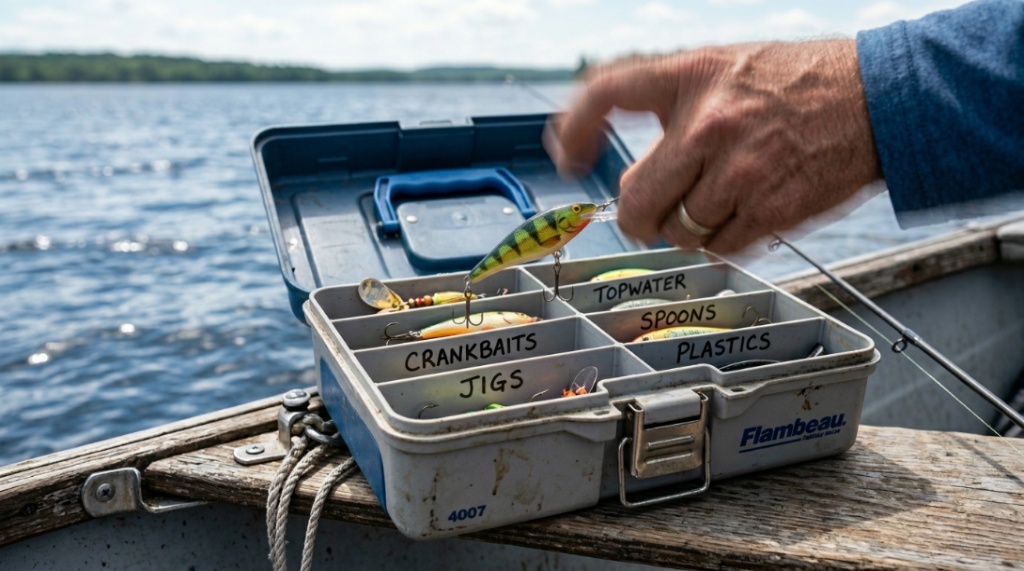
The fastest anglers don’t organize by lure category—they organize by fishing scenario:
Complete technique bundles: Everything for one approach lives together. Drop-shot bundle: hooks, weights, swivels, soft plastics, leader material — all in one section. When you decide on “drop-shot,” you open one location, and everything is there. No pulling pieces from four different compartments.
Pre-rigged backup leaders: Leaders pre-tied with hooks/jigs are stored in a leader wallet. When you break off, you tie a loop-to-loop, and you’re fishing again in 30 seconds instead of 4 minutes of retying. Keep 3-5 pre-rigged leaders for your primary technique visible in Zone 1.
Parallel organization: If you run two rods, organize tackle so each rod’s needs are in separate, non-overlapping sections. Left side of bag = rod 1 tackle. Right side = rod 2 tackle. No cross-contamination, no confusion about which tackle serves which setup.
Visual separation: Use colored tray dividers, labeled compartments, or different colored bags/pouches to create instant visual identification. When hands are wet and light is low, color recognition is faster than reading labels or remembering positions.
What’s the Best Way to Set Up a Kayak Fishing Tackle Bag for Access?
Kayak fishing presents the ultimate accessibility challenge — minimal space, no standing room, and gear must be reachable from a seated position:
- Milk crate with forward-facing trays: Trays oriented so lids open toward you (not sideways). This means one-arm reach, lid flip, grab, and you’re fishing. Trays facing sideways require twisting your entire body.
- Tackle bag between legs or on lap: A small soft bag positioned between your knees puts Zone 1 and 2 items within arm’s reach without turning. Bags with magnetic closures or velcro-flap tops avoid fumbling with zippers.
- Rod-holder-mounted tool station: Pliers, a cutter, and a hook remover mounted on a rod holder or track rail at elbow height. These tools are used most frequently and should never require reaching behind you or into a compartment.
- Deck-mounted tackle pods: Small waterproof containers adhered to the kayak deck in your forward field of vision. They hold 5-10 items you’ll swap throughout the day—extra jig heads, different weight sizes, and spare soft plastic tails.
For detailed recommendations on bags that work specifically in tight fishing spaces, this guide on fishing tackle storage bags and wraps reviews options rated for accessibility in various fishing environments.
How Do You Keep Tackle Accessible During Night Fishing?
Low-light conditions expose every flaw in your organizational system. What works fine at noon becomes impossible at 10 PM without specific accommodations:
Tactile identification: Different texture tray surfaces or rubber bands around specific trays let you identify them by touch. “Smooth tray = crankbaits, ribbed tray = soft plastics” works without any light.
Consistent positioning: If you always put your drop-shot tray in the upper-left slot and your jig tray in the upper-right, muscle memory takes over in darkness. Consistency is more important than labeling when you can’t see labels.
Red-light headlamp compatibility: Red light preserves night vision while illuminating tackle. Organize so your most-used items face upward (visible from a standing headlamp angle). Reflective divider labels visible under dim light add another layer.
Simplification: Night fishing tackle should be half (or less) of your daytime loadout. Fewer options = faster finding. Bring only what’s proven for nighttime patterns and leave the “maybes” at home.
What Maintenance Habits Keep Tackle Accessible Long-Term?
Accessibility degrades without maintenance. These habits keep systems running smoothly:
- Immediate return protocol: Every item goes back in its exact spot the moment you’re done with it. Not “later” — now. Delaying return is how organized systems collapse into chaos within 3 trips.
- Post-trip 5-minute reset: Before leaving the water, spend 5 minutes confirming everything is in its home position. Latch all trays. Close all pockets. This prevents the “stuff was everywhere last time” problem on your next trip.
- Weekly tray inspection: Open each tray you used and check for misplaced items, tangled hooks, or shifted dividers. A 2-minute check prevents items from migrating to wrong compartments over time.
- Restock immediately: When you notice something is getting low (hooks, weights, soft plastics), add it to your buy list immediately. An empty compartment that should hold split-shots slows you down next trip. Restock before you need to.
How Do You Balance Accessibility with Protection?
There’s an inherent tension: more accessible means more exposed. Here’s how to balance both:
Waterproof interior, easy-open exterior: Use bags with DWR-coated fabric and sealed bottom seams for protection, but quick-release buckles or magnetic flaps for access speed. You get weather protection without zipper fumbling.
Clear-lid trays: See contents without opening (protection maintained) and know exactly which compartment to go to once you do open (speed). The clear lid is both a protector and an accelerator.
Exposed tools, enclosed tackle: Pliers, cutters, and hemostats can live outside the bag (they’re metal, they’re waterproof). Hooks, soft plastics, and electronics stay inside protected compartments. Different protection levels for different item categories.
Sacrificial outer layer: A rain cover or splash guard that adds protection in bad weather but removes in 2 seconds when conditions are fine. Protection when needed, accessibility when the weather cooperates.
When you invest time to keep fishing tackle organized and easy to access, you ensure that every moment on the water is focused on the fish, not the clutter. Organization saves you from unnecessary frustration and maximizes efficiency. However, efficiency also depends on your physical comfort during long days of casting and reeling. If repetitive motion or strain is hindering your performance, it might be time to address the discomfort. For practical advice on managing physical strain, read our guide on Find the Best Wrist Brace for Fishing to stay in top form all season long.
FAQ
What’s the fastest tackle access system for bank fishing?
A tackle sling worn cross-body with forward-facing compartments. Everything sits at hip level, accessible with one hand while the other holds your rod. No setting bags down, no bending over, no taking off a backpack. Combined with a small leader wallet in a chest pocket, this setup delivers sub-5-second access to any item you carry.
Is a fishing tackle bag really better than a tackle box for accessibility?
For mobile fishing (bank, wade, kayak), yes — significantly. Bags offer multiple access points, body-worn convenience, and better space conformity. For stationary boat fishing with permanent deck storage, hard boxes can work equally well since they sit open beside you all day. The “better” answer depends on whether you’re moving or stationary.
How many items should I carry for a typical 4-hour fishing trip?
For one target species and 2-3 techniques, 30-50 individual items is optimal. That covers primary baits (8-12), backup colors (6-8), terminal tackle (hooks/weights/swivels for each technique), tools (3-4), and personal items. More than 80 items typically means you’re carrying “just in case” tackle that slows you down more than it helps.
What’s the best tackle box alternative for wade fishing?
A waterproof chest pack combined with a wading belt that holds 1-2 small boxes. Everything stays above water level and at hand height. Chest packs from brands like Umpqua, Fishpond, and Simms offer well-designed compartments specifically for wade-fishing accessibility. Avoid anything that hangs below waist level — it’ll get submerged.
How do I stop my tackle bag from becoming disorganized mid-trip?
The “immediate return” rule is everything. Every time you pull something out, the next action after using it is returning it to its spot — not setting it on the boat deck “for now.” Use trays with positive-close latches that click shut (preventing accidental opening during transport) and bags with structured compartments that hold shape even when items are removed.
Should I buy matching bags/trays from one brand or mix brands?
Standardize tray size (3600 or 3700) across all brands—they’re dimensionally compatible. For bags, buy what has the best access design for your fishing style regardless of brand. One brand’s tray fits perfectly in another brand’s bag if the size standard matches. Brand matching is marketing, not functional necessity.
What’s the minimum tackle bag setup for someone just getting serious about organization?
Start with: one quality soft-sided bag that holds 4x 3600 trays, four trays with adjustable dividers organized by technique, a leader wallet in the top pocket, and external plier/tool holders. Total investment: $60-90. This foundation covers 90% of single-species fishing needs and expands easily by adding trays and modules over time.