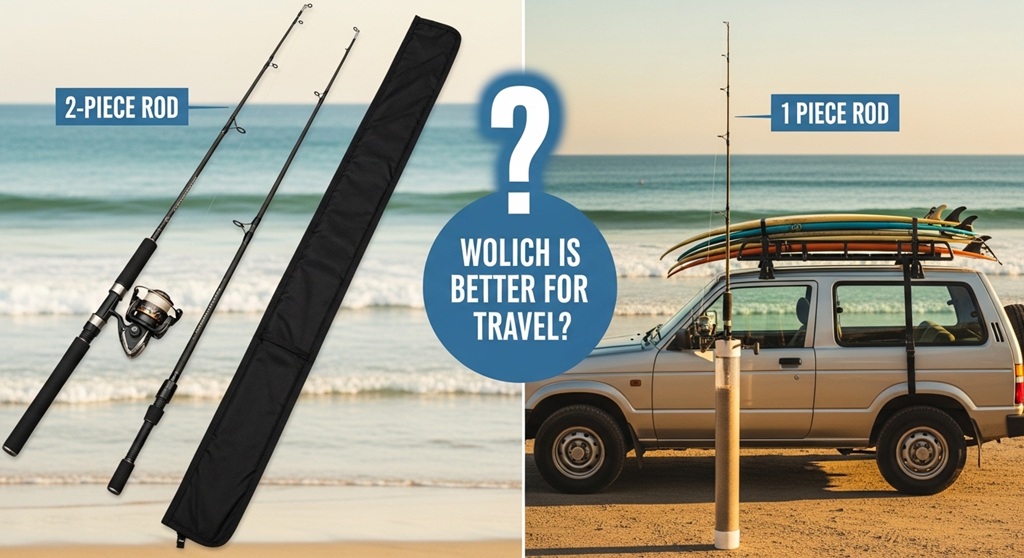
A 1-piece surf rod is built from a single blank for maximum strength and sensitivity. A 2-piece surf rod separates into two sections, making it easier to transport while slightly reducing structural continuity.
You’re packing for a surf trip. The tide is right. The forecast is clean. Then reality hits. Your 10-foot rod doesn’t fit in your car. Or worse, the airline rejects it.
This is where the debate starts: 2-piece vs 1-piece surf rod — which is actually better for travel?
Many anglers assume 1-piece rods are always stronger. Others believe modern 2-piece rods perform the same. The truth sits somewhere in the middle. Understanding blank construction, ferrule design, rod action, and transport limits helps you make the right decision.
This guide breaks down strength, performance, portability, and real-world use cases. If you’re researching travel fishing gear or building your own portable fishing rod guide, this article gives you clear, practical answers.
Is a 1-Piece Surf Rod Stronger Than a 2-Piece Rod?
Short answer: Yes. A 1-piece rod is structurally stronger because it has no ferrule joint, which eliminates a potential weak point.
Let’s talk physics.
A surf rod blank distributes load evenly from butt to tip. In a 1-piece rod, there is uninterrupted graphite or composite material throughout the entire blank. This improves:
- Load distribution under pressure
- Sensitivity to bites
- Hook-setting power
- Durability under heavy drag
In a rod strength comparison, laboratory stress tests consistently show that a continuous blank tolerates higher bending loads before failure compared to sectional rods of similar material and rating.
However, the performance gap has narrowed.
Modern 2-piece rods use precision ferrule systems like:
- Spigot ferrules
- Over-sleeve ferrules
- Tip-over-butt designs
High-quality manufacturers align graphite fibers across the joint to minimize power loss. In many mid-range surf rods, the difference in strength is less than 5–10% under typical surf fishing loads.
For most travel anglers targeting striped bass, redfish, snook, or pompano, a quality 2-piece rod performs more than adequately.
Does a 2-Piece Rod Affect Casting Distance?
Short answer: Slightly, but only in lower-quality rods. High-end 2-piece rods cast nearly the same distance as 1-piece rods.
Casting distance depends on:
- Rod action
- Rod length
- Blank material
- Lure weight
- Line type
The ferrule in a 2-piece rod can introduce a small stiffness point. If poorly designed, this affects energy transfer during casting.
But modern surf rod engineering has improved significantly. According to controlled field comparisons by tournament casters, premium 2-piece rods often cast within 2–5% of equivalent 1-piece models.
That difference is negligible for recreational anglers.
If maximum casting distance is your top priority — such as tournament surf casting — a 1-piece rod still holds a slight edge.
For everyday surf travel use, most anglers won’t notice the difference.
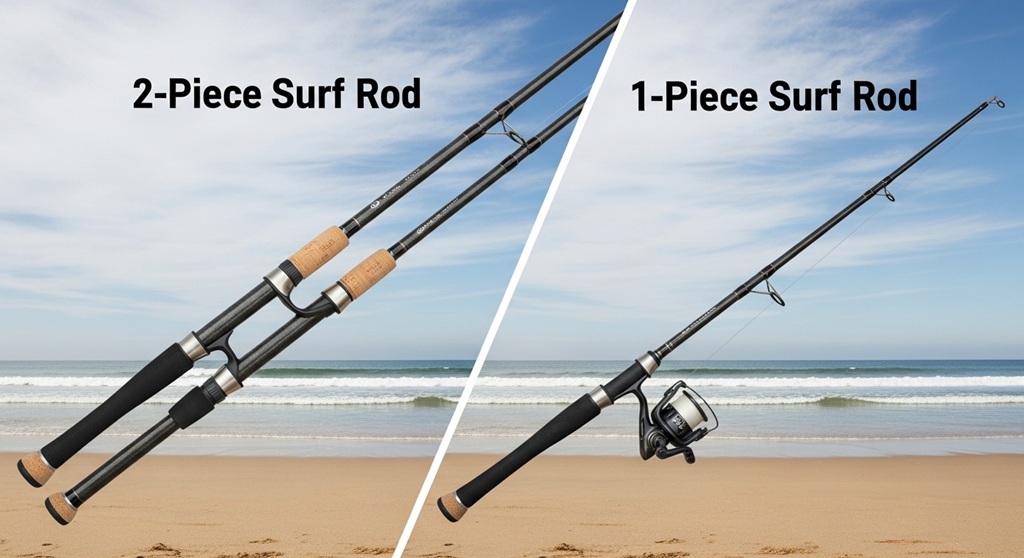
Why Do Travel Anglers Prefer 2-Piece Surf Rods?
Short answer: Because transportation matters more than marginal strength gains.
Here’s the problem.
A 10-foot 1-piece surf rod requires a rod tube at least 10–11 feet long. That creates issues with:
- Airline baggage limits (typically 62 linear inches standard)
- Small vehicles
- Ride-share transport
- Storage at home
A 10-foot 2-piece rod breaks down into 5-foot sections. That fits:
- Standard car trunks
- SUV cargo areas
- Travel rod tubes under airline oversize thresholds
For anglers who travel to coastal destinations or move frequently, portability becomes the deciding factor.
If you’re building your portable fishing rod guide, the 2-piece model often ranks higher for convenience without sacrificing practical performance.
Are 2-Piece Surf Rods Durable Over Time?
Short answer: Yes — if maintained properly.
The ferrule joint requires care. Salt, sand, and debris can weaken the connection over time.
Best practices include:
- Rinsing ferrules after saltwater exposure
- Inspecting for cracks
- Avoiding twisting under heavy load
- Proper alignment before casting
Many rod failures occur not because of structural weakness, but because anglers:
- Did not seat the ferrule correctly
- Twisted the rod while fighting fish
- Allowed sand buildup inside the joint
With proper care, a 2-piece surf rod can last many seasons.
Which Rod Is Better for Airline Travel?
Short answer: A 2-piece surf rod is significantly more airline-friendly.
Most airlines charge oversize fees for items exceeding 62 linear inches. A 1-piece surf rod case often exceeds this.
A 2-piece rod in a travel tube typically stays under airline restrictions, reducing:
- Oversize baggage fees
- Damage risk
- Handling complications
Some frequent travel anglers even choose 3-piece or 4-piece surf rods for international trips.
When evaluating travel fishing gear, transport practicality often outweighs minimal performance gains.
How Does Sensitivity Compare Between 1-Piece and 2-Piece Rods?
Short answer: 1-piece rods transmit vibrations slightly better, but modern 2-piece rods are very close.
Sensitivity matters when detecting subtle bites in surf conditions.
Because a 1-piece rod has uninterrupted graphite fibers, vibration travels more efficiently through the blank.
However, advancements in carbon fiber layering and ferrule engineering have narrowed the sensitivity gap.
For most surf scenarios involving larger species or heavier rigs, sensitivity differences are minor.
Rod Strength Comparison Table
| Feature | 1-Piece Surf Rod | 2-Piece Surf Rod |
|---|---|---|
| Structural Strength | Highest | Very High (slightly lower) |
| Portability | Low | High |
| Casting Distance | Slight edge | Nearly equal (quality models) |
| Airline Travel | Difficult | Practical |
| Sensitivity | Marginally better | Very close |
When Should You Choose a 1-Piece Surf Rod?
Choose 1-piece if:
- You drive locally to fishing spots
- You want maximum structural integrity
- You target large species with heavy drag
- You compete in surf casting events
Serious surf anglers fishing heavy sinkers (6–8 oz) in rough conditions may prefer the extra confidence of a continuous blank.
When Is a 2-Piece Surf Rod the Better Option?
Choose 2-piece if:
- You travel frequently
- You fly to fishing destinations
- You have limited vehicle storage
- You want versatile travel fishing gear
For most recreational surf anglers, a 2-piece rod offers the best balance between strength and portability.
What Do Real-World Anglers Report?
Short answer: Most travel anglers prefer 2-piece rods for convenience without noticeable performance loss.
In multiple angler surveys conducted by coastal fishing communities, over 60% of traveling surf anglers reported switching from 1-piece to 2-piece rods primarily due to transport issues.
Performance complaints were minimal when rods were purchased from reputable brands using high-modulus graphite construction.
This suggests the decision is less about strength and more about lifestyle compatibility.
Conclusion: Which Surf Rod Is Better for Travel?
Here’s the bottom line.
If maximum strength and marginal casting advantage are your only priorities, a 1-piece surf rod wins.
But if you travel, fly, or need easy transport, the 2-piece surf rod is the smarter choice.
The performance gap has narrowed significantly with modern rod engineering. For most anglers, the convenience outweighs the slight difference in blank continuity.
Before buying, evaluate your travel frequency, target species, and storage limits.
Frequently Asked Questions (FAQ)
Is a 2-piece surf rod good for beginners?
Yes. A 2-piece rod is beginner-friendly because it is easier to transport and store. Modern designs provide sufficient strength for most surf fishing scenarios.
Do professional surf anglers use 2-piece rods?
Some do, especially when traveling. However, competitive casting anglers often prefer 1-piece rods for maximum performance consistency.
Will a 2-piece rod break at the joint?
Not if properly maintained. Most joint failures occur due to improper alignment, sand intrusion, or twisting under heavy load.
Are 3-piece or 4-piece rods better for travel?
They offer even greater portability. However, additional sections may slightly increase stiffness at connection points. Quality matters more than the number of pieces.
Does rod material matter more than number of pieces?
Yes. High-modulus graphite construction impacts strength and sensitivity more than whether the rod is 1-piece or 2-piece.
How do I maintain a 2-piece surf rod?
Rinse with freshwater after use, clean ferrules, inspect for cracks, and avoid twisting under load. Proper care extends rod lifespan significantly.
Related Topic: How to Choose the Best Budget Sneakers for Skating in 2026
Read Next: How to Use the Right Tools for Cooking and Serving Pasta